

Showing posts with label Physic. Show all posts
Showing posts with label Physic. Show all posts
Saturday, October 31, 2009


Thursday, September 24, 2009
SPM Trial Exam 2009 (Physics)
SPM Trial Exam 2009
Negeri 9
Physics - Paper 1 [Download]
Physics - Paper 2 [Download]
Physics - Paper 3 [Download]
Physics - Marking Scheme [Download]Kedah
Physics - Paper 1 [Download]
Physics - Paper 2 [Download]
Physics - Paper 3 [Download]
Physics - Marking Scheme [Download]Johor
Physics - Paper 1 [Download]
Physics - Paper 2 [Download]
Physics - Paper 3 [Download]
Physics - Marking Scheme [Download]Perlis
Physics - Paper 1 [Download]
Physics - Paper 2 [Download]
Physics - Paper 3 [Download]
Physics - Marking Scheme [Download]
SBP
Sabah
*Credits to CIkgu Alan Kho
MelakaSBP
Physics - Paper 1 [Download]
Physics - Paper 2 [Download]
Physics - Paper 3 [Download]
Physics - Marking Scheme [Download]Sabah
Physics - Paper 1 [Download]
Physics - Paper 2 [Download]
Physics - Paper 3 [Download]
Physics - Marking Scheme [Download]*Credits to CIkgu Alan Kho
Physics - Paper 1 [Download]
Physics - Paper 2 [Download]
Physics - Paper 3 [Download]
Physics - Marking Scheme [P1] [P2] [P3]
Wednesday, July 29, 2009
PhysicKU dlm Kritikal
Oleh i2..
aku nak study nota2 kat bwh nie!.
aku copy link nota kt bwh nie(hehe)
senang..
jom blajar sama2
diambil di dlm blog http://fiziknota.blogspot.com
aku nak study nota2 kat bwh nie!.
aku copy link nota kt bwh nie(hehe)
senang..
jom blajar sama2
Chapter 9.0 Electronics
- Uniderstanding Semiconductor Diodes
- Uses of Semiconductor Diodes
- Understanding Transistors
- Applications of Transistors
- Cathode Ray Oscilloscope
- Properties of Cathode Rays
- Cathode Ray Oscilloscope: Thermionic Emission
diambil di dlm blog http://fiziknota.blogspot.com
Monday, July 20, 2009
40 formulae (physics form4)
kalo ader silap or tkurg dharap tlg tegoq dan tambah
1-velocity..........v=s/t t=s/v s=vt
2-acceleration......a=(v-u)/t
3-linear motion (1) v=u+at (utk xdak s)
4-linear motion (2) s=[(v+u)/2]t (utk tadak a)
5-linear motion (3) s=ut+1/2at2 (kuasa 2) (utk tadak v)
6-linear motion (4) s=vt-1/2at2 (kuasa 2) (utk tadak u)
7-linear motion (5) v2 (kuasa 2)=u2 (kuasa 2)+2as (utk tadak t)
8-momentum.............................p=mv
9-elastic collision (yg lain)..........m1u1+m2u2=m1v1+m2v2
10-inelastic collision (yg sama).......m1u1+m2u2=(m1+m2)v
11-explosion...........................0=m1v1+m2v2
12-force...............................F=ma
13-impulse.............................Ft=m(v-u)
14-gravitational field strength (xjumpak formula dia)
15-weight .....................w=mg
16-work done...................w=Fs
17-kinetic energy..............Ek (k kecik ltaknya di tepi bawah E)=1/2mv2 (kuasa 2)
18-potential energy..........Ep (p kecik ltaknya di tepi bwh E)=mgh
19-power..........................P=Fv
20-force (utk elasticity).....F=kx
21-force constant....................................k=F/x
22-potential energy (for elasticity)..........Ep(p kecik ltaknya ditepi bwh E)=1/2Fx
23-change in momentum.........................=m(v-u)
24-increase in kinetic energy...................=1/2m(v2(kuasa2)-u2(kuasa 2))
25-pressure.............................................P=F/A
26-pressure (for liquid)............hpg
27-total pressure.....................Ptotal=Patm+hpg
28-pressure (for gas)...............Pgas=Patm-h
29-Pascal principle....................F1/A1=F2/A2 atau boley juga F1/F2=A1/A2
30-density................................=mass/volume
31-buoyant force (Archimedes principle)...........Fb(b kecik ltaknya ditepi bwh F)=pVg
32-specific heat capacity...................................Q=mc@ (@ tu theta)
33-Boyle's law...................................................P1V1=P2V2
34-Charles law..................................................V1/T1=V2/T2
35-Gay-Lussac's law..........................................P1/T1=P2/T2
36-refraction index........n=cv/cm (c is speed of light/v is vacuum/m is medium)
37-Snell's law................n=sin i/sin r
38-critical angle.............n=1/sin c
39-lens equation...........1/f=1/u+1/v
40-magnification............m=v/u
pergh....abes jugak aku 2lis....pc
skian trima kasihclap
1-velocity..........v=s/t t=s/v s=vt
2-acceleration......a=(v-u)/t
3-linear motion (1) v=u+at (utk xdak s)
4-linear motion (2) s=[(v+u)/2]t (utk tadak a)
5-linear motion (3) s=ut+1/2at2 (kuasa 2) (utk tadak v)
6-linear motion (4) s=vt-1/2at2 (kuasa 2) (utk tadak u)
7-linear motion (5) v2 (kuasa 2)=u2 (kuasa 2)+2as (utk tadak t)
8-momentum.............................p=mv
9-elastic collision (yg lain)..........m1u1+m2u2=m1v1+m2v2
10-inelastic collision (yg sama).......m1u1+m2u2=(m1+m2)v
11-explosion...........................0=m1v1+m2v2
12-force...............................F=ma
13-impulse.............................Ft=m(v-u)
14-gravitational field strength (xjumpak formula dia)
15-weight .....................w=mg
16-work done...................w=Fs
17-kinetic energy..............Ek (k kecik ltaknya di tepi bawah E)=1/2mv2 (kuasa 2)
18-potential energy..........Ep (p kecik ltaknya di tepi bwh E)=mgh
19-power..........................P=Fv
20-force (utk elasticity).....F=kx
21-force constant....................................k=F/x
22-potential energy (for elasticity)..........Ep(p kecik ltaknya ditepi bwh E)=1/2Fx
23-change in momentum.........................=m(v-u)
24-increase in kinetic energy...................=1/2m(v2(kuasa2)-u2(kuasa 2))
25-pressure.............................................P=F/A
26-pressure (for liquid)............hpg
27-total pressure.....................Ptotal=Patm+hpg
28-pressure (for gas)...............Pgas=Patm-h
29-Pascal principle....................F1/A1=F2/A2 atau boley juga F1/F2=A1/A2
30-density................................=mass/volume
31-buoyant force (Archimedes principle)...........Fb(b kecik ltaknya ditepi bwh F)=pVg
32-specific heat capacity...................................Q=mc@ (@ tu theta)
33-Boyle's law...................................................P1V1=P2V2
34-Charles law..................................................V1/T1=V2/T2
35-Gay-Lussac's law..........................................P1/T1=P2/T2
36-refraction index........n=cv/cm (c is speed of light/v is vacuum/m is medium)
37-Snell's law................n=sin i/sin r
38-critical angle.............n=1/sin c
39-lens equation...........1/f=1/u+1/v
40-magnification............m=v/u
pergh....abes jugak aku 2lis....pc
skian trima kasihclap
Wednesday, July 15, 2009
Newton's Laws (physic)
Lesson 1: Newton's First Law of Motion
Lesson 2: Force and Its Representation
Lesson 3 : Newton's Second Law of Motion
- Newton's Second Law
- The Big Misconception
- Finding Acceleration
- Finding Individual Forces
- Free Fall and Air Resistance
Lesson 4 : Newton's Third Law of Motion
Saturday, June 27, 2009
Revision card ( Physic notes)
Form 4
1 Introduction to Physics
1.1 Physical Quantities
1.2 Error Analysis
1.3 Measurement
1.4 Scientific Investigation
2 Force and Motion
2.1 Linear Motion
2.2 Ticker Tape
2.3 Graph of Motion
2.4 Mass and Inertia
2.5 Momentum
2.6 Effects of a Force
2.7 Impulse and Impulsive Force
2.8 Safety Feature in Vehicles
2.9 Gravity
2.10 Forces in Equilibrium
2.11 Work and Energy
2.12 Power and Efficiency
2.13 Elasticity
3. Force and Pressure
3.1 Pressure
3.2 Liquid Pressure
3.3 Atmospheric Pressure
3.4 Application of Atmospheric Pressure
3.5 Gas Pressure
3.6 Pascal's Principle
3.7 Archimedes Principle
3.8 Bernoulli's Principle
4. Heat
4.1 Thermal Equilibrium
4.2 Thermometer
4.3 Specific Heat Capacity
4.4 Application of Specific Heat Capacity
4.5 Specific Latent Heat
4.6 The Gas Law
5. Light
5.1 Reflection
5.2 Refraction
5.3 Critical Angle and Total Internal Reflection
5.4 Lenses
5.5 Optical Instrument
Form 5
1. Wave
1.1 Oscillation
1.2 Understanding Wave
1.3 Phenomena of Wave 1 - Reflection and Refraction
1.4 Phenomena of Wave 2 - Diffraction
1.5 Phenomena of Wave 3 - Interference
1.6 Sound Wave
1.7 Electromagnetic Wave
1.8 Electromagnetic Wave 2 - Light Wave
2. Electricity
2.1 Electric Charge and Current
2.2 Electric Field
2.3 Potential Difference, Ohm's Law and Resistance
2.4 Series Circuit and Parallel Circuit
2.5 Electromotive Force and Internal Resistance
2.6 Electrical Energy and Power
2.7 Efficiency Use of Electrical Appliances
3. Electromagnetism
3.1 Magnetism (Revision)
3.2 Electromagnet
3.3 Application of Electromagnet
3.4 Force on a Current-carrying Conductor in a Magnetic Field
3.5 Electromagnetic Induction
3.6 Alternating Current
3.7 Transformer
3.8 Sources of Energy and Generation of Electricity
3.9 Transmission of Electricity

Sunday, June 14, 2009
Voltmeter Design
Voltmeter Design
Voltmeters, as well as ammeters and ohmmeters, are designed with the use of a sensitive current detector such as a galvanometer.
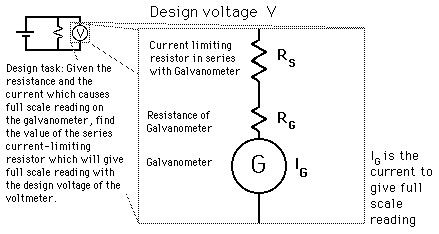
A voltmeter is placed in parallel with a circuit element to measure the voltage drop across it and must be designed to draw very little current from the circuit so that it does not appreciably change the circuit it is measuring. To accomplish this, a large resistor is placed in series with the galvanometer. Its value is chosen so that the design voltage placed across the meter will cause the meter to deflect to its full-scale reading. A galvanometer full-scale current is very small: on the order of milliamperes.
Did you know physics fact well?
Some remarkable physics facts
- When a flea jumps, the rate of acceleration is 20 times that of the space shuttle during launch
- If every star in the Milky Way was a grain of salt they would fill an Olympic sized swimming pool.
- 12 Astronauts have walked on the moon, bringing back 382 kilograms of rocks, pebbles, sand and dust between them
- Whales talk to each other by making a loud clicking noise. The sound waves travel extremely well underwater so they can hear each other from 100 miles away.
- A TV screen shows 24 pictures a second. Because a fly sees 200 images a second, it would see TV as still pictures with darkness in between.
- Cats can see clearly in one-sixth the amount of light we humans would need. This is due to a special layer of cells at the back of their retinas, which acts like a mirror, reflecting light back to the retina's cells.
- In 1936 Professor Alfred Gaydon underwent surgery on his eyes after an accident. When his sight began to return he found that he could see ultra-violet light, which is normally beyond the visible spectrum of humans. This helped in his work as a physicist, but it did distort how he saw other colours!
- The Eiffel Tower is 15cm taller in summer because of thermal expansion.
- Some people who have two or more different kinds of fillings in their teeth are able to hear high-power AM broadcast stations when located within a few hundred feet of the stations. In such cases, the radio waves act upon the teeth fillings in such a way that the electromagnetic oscillations get transformed to mechanical vibrations in the person's head, and these are heard as sound.
- The amount of sunlight reaching the earth's surface is 6,000 times the amount of energy used by all human beings worldwide. The total amount of fossil fuel used by humans since the start of civilization is equivalent to less than 30 days of sunshine.
Friday, June 12, 2009
SPM 'A' tips: Stop Procrastinating
By cikgu physic
http://www.physics4spm.com/
Most of u might realizes that one of the most common problems when studying is procrastination( suka bertangguh). We all know what we want to do and what we should be doing... but in the end we still end up spending hours doing “easier” work like watcin TV, surfing internet,doing facebook & myspace, playing 'stupid' games,or listen too much of music.
Now, nothing wrong with a little escape from time to time. But if you procrastinate too much..
dont blame others if u cant get a good results for your SPM...
U should blame urself for playing games sampai 4 hours, but spent only 1.5 hrs hours doing revision during this cuti skolah.
So.. how can you change this bad habit? Here i will only share 2 tips to help you to stop procrastinating and start appreciatin your priceless time from now on.
so these tips are very usefull for my form4 students..no honeymoon year ok :), othrwise u end up like some of those 'cool' spm candidates...
though it seems a bit late for them, its better to start to do something rather than doin nothing..
Ok..1st rule:
Stop thinking... Start doing.
A bit of planning can certainly help you to achieve what you want to achieve.
'Too much planning and thinking' tends to have the opposite effect. You always think and think and try to come up with “the perfect plan”. A plan where you don’t have to make mistakes, where you will never be rejected, where there will be no pain or difficulties. Such a thing does of course not exist. But as long as you work on what u've planned, you can protect yourself.. at least from getting 'F' :)
U can start with a simpleplan. What i mean of simple plan is go & do your study time table NOW! Then execute it..
2nd rule:
Just take the 1st STEP
Focus on taking the first step today. That is all you need to focus on, nothing else. By taking the first step you change your mental state from resistant to “hey, I’m doing this,.. it seems cool babe”. SO..You've put yourself in state where you are becoming more positive. We need this positive energy..Then you can take the next step..and another step further..untill u can do it consistantly.
As for the beginning..here i attached a few collection of midterm exam papers from Melaka.
So what are u waiting for..go & try them! .. take the very 1st step :)..no more procrastinatingg...just say TAK NAK!
Physics [Paper1] [Paper2]
Chemistry [Paper1] [Paper2] [Paper3]
Biology [Paper1] [Paper2] [Paper3]
Add Maths [Paper1] [Paper2]
http://www.physics4spm.com/
Most of u might realizes that one of the most common problems when studying is procrastination( suka bertangguh). We all know what we want to do and what we should be doing... but in the end we still end up spending hours doing “easier” work like watcin TV, surfing internet,doing facebook & myspace, playing 'stupid' games,or listen too much of music.
Now, nothing wrong with a little escape from time to time. But if you procrastinate too much..
dont blame others if u cant get a good results for your SPM...
U should blame urself for playing games sampai 4 hours, but spent only 1.5 hrs hours doing revision during this cuti skolah.
So.. how can you change this bad habit? Here i will only share 2 tips to help you to stop procrastinating and start appreciatin your priceless time from now on.
so these tips are very usefull for my form4 students..no honeymoon year ok :), othrwise u end up like some of those 'cool' spm candidates...
though it seems a bit late for them, its better to start to do something rather than doin nothing..
Ok..1st rule:
Stop thinking... Start doing.
A bit of planning can certainly help you to achieve what you want to achieve.
'Too much planning and thinking' tends to have the opposite effect. You always think and think and try to come up with “the perfect plan”. A plan where you don’t have to make mistakes, where you will never be rejected, where there will be no pain or difficulties. Such a thing does of course not exist. But as long as you work on what u've planned, you can protect yourself.. at least from getting 'F' :)
U can start with a simpleplan. What i mean of simple plan is go & do your study time table NOW! Then execute it..
2nd rule:
Just take the 1st STEP
Focus on taking the first step today. That is all you need to focus on, nothing else. By taking the first step you change your mental state from resistant to “hey, I’m doing this,.. it seems cool babe”. SO..You've put yourself in state where you are becoming more positive. We need this positive energy..Then you can take the next step..and another step further..untill u can do it consistantly.
As for the beginning..here i attached a few collection of midterm exam papers from Melaka.
So what are u waiting for..go & try them! .. take the very 1st step :)..no more procrastinatingg...just say TAK NAK!
Physics [Paper1] [Paper2]
Chemistry [Paper1] [Paper2] [Paper3]
Biology [Paper1] [Paper2] [Paper3]
Add Maths [Paper1] [Paper2]
Monday, June 1, 2009
How to Study Physics for SPM?
-By cikgu fizik-
Blog cikgu fizik
Although I scored an A1 in Physics for SPM, I am not exactly the right person to be asked, "how did you do it?" So, I posed the question to my friend, Jasmine, instead to see what she had to say. Jasmine and I have known each other for 5 years (yes, throughout my secondary school years) but, our fathers know each other longer than that! Anyway, here is what she had to say:
Firstly, Physics is very different compared to the other subjects. Physics is one of the toughest Science subjects for many people. Physics is more to the Maths side as it is mostly calculations, formulaes and principles.. Biology is 100% memorising, Chemistry is 50% calculation, 50% memorising, Physics on the other hand is 100% calculation and formulaes. The study of Physics is very deep and it involves a lot of techincal details: heat, electricity, electronics and so forth. Every minor detail is important and that makes the subject complex and sometimes even tedious. Nevertheless, once mastered, Physics is very useful for survival purposes in our daily life.
One very important thing in Physics is understannding. You must understand what you are learning, not just memorise for the sake of exam. Physics is actually an easy subject to study. All you must know are the formulaes and principles involved.. What usually happens is the teacher will twist the questions and asked them from different angles. That is when it becomes tough. What you must remember is the basic pronciples involved. No matter how tough the question is, in the end, it will always go back to the basic principles.
I would recommend a good revision book for this subject as the school textbook alone is not enough to score. Pay attention in class and ask questions whwnever you don't understand. Do not be scared or shy to question your teachers as it is necessary for you to know in detail about Physics. For eg:
Where did the formulaes come from, how are they derived, how are the variables involved connected to each other, conversion of units and many more.
Master your calculations and make sure you choose the right formulaes for each question. This can be a problem sometimes. Physics is not a mugging subject, you cannot simply study it by the book. You must attempt questions from workbooks and do a lot of exercises. Only then you will be exposed to a wide range of different ways questions can be asked. Hence, you will be able to answer various types oy questions no matter how tough they may seem.
Interest plays a vital role in scoring in this subject. You must show keen interest in studying Physics. Most people dislike the subject as it is far more complicating then the other Science subjects. Therefore, they make no effort to master the subject.
Finally, try attempting the past year questions for Physics. Analyse the questions and topics that have come out in the previous years. SPM questions are always very similar, so chances of the same type of questions coming out every year is very high. Please take note, same type of questions, not same questions. Make sure that you are able to do all the past year questions. If so, you will not have a problem during the actual exam.
It is very important for you to understand in Physics. You MUST know what you are studying. Only then will you be able to score in the subject. Physics is not a difficult subject. I feel that it is much easier than Biology and Chemistry, bur it requires a lot of patience, interest and understanding.
NEXT, I asked her what type of reference books she would recommend. Also asked why she was very interested in the subject.
I don't know what are the reference books they have nowadays for Physics but I would recommend either Success or Focus. I found both quite good. But you can also check out the others that are there now.
I was always interested in tools and mechanical stuff ever since I was small. I love playing with my father's gadgets even now and I suppose that's why I love Physics. This is something that has to come from within I guess.
Blog cikgu fizik
Although I scored an A1 in Physics for SPM, I am not exactly the right person to be asked, "how did you do it?" So, I posed the question to my friend, Jasmine, instead to see what she had to say. Jasmine and I have known each other for 5 years (yes, throughout my secondary school years) but, our fathers know each other longer than that! Anyway, here is what she had to say:
Firstly, Physics is very different compared to the other subjects. Physics is one of the toughest Science subjects for many people. Physics is more to the Maths side as it is mostly calculations, formulaes and principles.. Biology is 100% memorising, Chemistry is 50% calculation, 50% memorising, Physics on the other hand is 100% calculation and formulaes. The study of Physics is very deep and it involves a lot of techincal details: heat, electricity, electronics and so forth. Every minor detail is important and that makes the subject complex and sometimes even tedious. Nevertheless, once mastered, Physics is very useful for survival purposes in our daily life.
One very important thing in Physics is understannding. You must understand what you are learning, not just memorise for the sake of exam. Physics is actually an easy subject to study. All you must know are the formulaes and principles involved.. What usually happens is the teacher will twist the questions and asked them from different angles. That is when it becomes tough. What you must remember is the basic pronciples involved. No matter how tough the question is, in the end, it will always go back to the basic principles.
I would recommend a good revision book for this subject as the school textbook alone is not enough to score. Pay attention in class and ask questions whwnever you don't understand. Do not be scared or shy to question your teachers as it is necessary for you to know in detail about Physics. For eg:
Where did the formulaes come from, how are they derived, how are the variables involved connected to each other, conversion of units and many more.
Master your calculations and make sure you choose the right formulaes for each question. This can be a problem sometimes. Physics is not a mugging subject, you cannot simply study it by the book. You must attempt questions from workbooks and do a lot of exercises. Only then you will be exposed to a wide range of different ways questions can be asked. Hence, you will be able to answer various types oy questions no matter how tough they may seem.
Interest plays a vital role in scoring in this subject. You must show keen interest in studying Physics. Most people dislike the subject as it is far more complicating then the other Science subjects. Therefore, they make no effort to master the subject.
Finally, try attempting the past year questions for Physics. Analyse the questions and topics that have come out in the previous years. SPM questions are always very similar, so chances of the same type of questions coming out every year is very high. Please take note, same type of questions, not same questions. Make sure that you are able to do all the past year questions. If so, you will not have a problem during the actual exam.
It is very important for you to understand in Physics. You MUST know what you are studying. Only then will you be able to score in the subject. Physics is not a difficult subject. I feel that it is much easier than Biology and Chemistry, bur it requires a lot of patience, interest and understanding.
NEXT, I asked her what type of reference books she would recommend. Also asked why she was very interested in the subject.
I don't know what are the reference books they have nowadays for Physics but I would recommend either Success or Focus. I found both quite good. But you can also check out the others that are there now.
I was always interested in tools and mechanical stuff ever since I was small. I love playing with my father's gadgets even now and I suppose that's why I love Physics. This is something that has to come from within I guess.
So, there you have it. Feel free to add on to the above mentioned points. One question for all of you out there, how do you spark an interest in Physics?
Wednesday, May 13, 2009
..-Express revision notes 4 physics-...
SPM: Express Revision Notes
In physics ..Pressure = (Force) / (Area)
.. the bigger the force, the larger the pressure
..the smaller the area, the larger the pressure
applying this concept, i can derive a new formula called 'SPM PRESSURE'..
In SPM, ..PRESSURE = (No. of SUBJECT) / ( time)
(No. of subject) can be considered as no. of weight u have to carry, thus if u take more subject, the pressure is getting HIGHER..
As for time, if u have less time or when the time is getting closer towards SPM, the PRESSURE will be mounting HIGHER as well..
To summarize this new formula, if u r studying last minute.. your time is getting lesser. Then i can conclude that "U WILL BE UNDER XTREME PRESSSSURE"
So don't wait until last minute..coz u 've at least 9 subjects to carry, berat tu :)
By the way,here i include those 'Express' notes in powerpoint version. The notes is useful if u wanna have a quick revision. Hopefully it can reduce your pressure :)
My last advice is..please plan your time. Dont procrastinate, coz it is a thieves of time.
I think thats it 4 now..see u in next post, bye & gudluck..
Form4 Express notes:
Chapter 1- Introduction to Physics
Chapter 2- Forces & Motion
Chapter 3- Forces & Pressure
Chapter 4- Heat
Chapter 5- Light
Form 5 Express notes:
Chapter 1- Waves
Chapter 2- Electricity
Chapter 3- Electromagnet
Chapter 4- Electronics
Chapter 5- Radioactive
(Thanx & best regards to the author for publishingg this notes on the web)
Wednesday, May 6, 2009
SPM Physics Form 5

Nota unt korang. Korang klik link mana yg korang nak..
- 1.1 Understanding Waves (4)
- 1.2 Wave Reflection (1)
- 1.3 Wave Refraction (3)
- 1.4 Wave Diffraction (2)
- 1.5 Wave Interference (5)
- 1.6 Sound Wave (2)
- 1.7 Electromagnetic Waves (2)
- 2.1 Electric Fields - Charge Flow (2)
- 2.2 Current and Potential Difference (2)
- 2.3 Series - Parallel Circuit (3)
- 2.4 E.M.F and Internal Resistance (1)
- 2.4 Analysing E.M.F and Internal Resistance (1)
- 2.5 Electrical Energy+Power (3)
- 3.1 Analysing Electromagnet (2)
- 3.2 Magnetic Force (5)
- Introduction (1)
- Miscellaneous (1)
- News (4)
- SPM Notes: Electricity (2)
- SPM Questions : Wave (5)
- SPM Questions: Electricity (4)
- SPM Questions: Electromagnet (2)
- SPM tips (2)
Subscribe to:
Posts (Atom)
Target selepas 3 bulan bekerja !
